
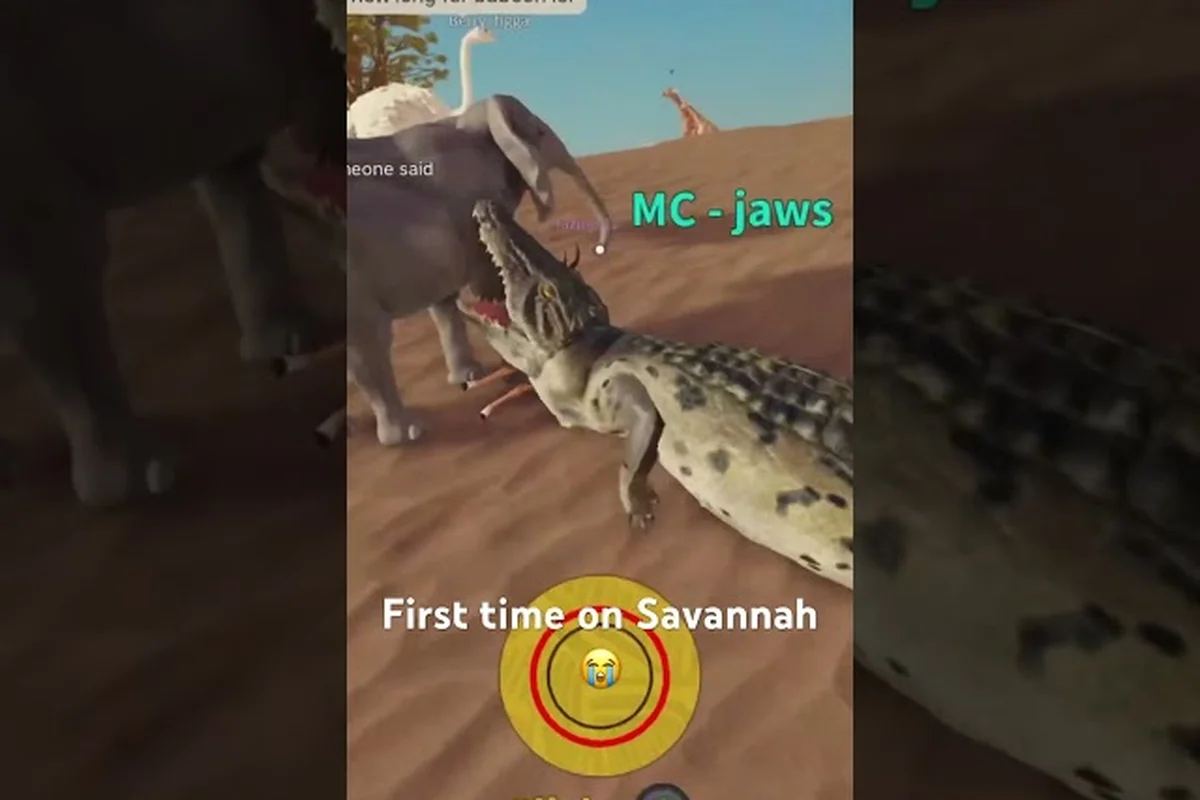
Savannah Life drops you straight onto a sun-baked plain as a baby herbivore, and the first five minutes decide whether you survive long enough to grow into an apex predator. This Savannah Life tutorial distills the controls, the eat-and-drink loop, and the early-game strategy that separate a quick respawn from a long run on the savannah, so you can spend less time guessing and more time hunting.
Getting Started in Savannah Life: Spawning, Animals, and the First Five Minutes
Your first job in Savannah Life is to survive long enough to understand what's trying to eat you. The game launches you into a server populated by other players, and every animal in that server follows the same eat-drink-grow loop — the difference is what role you pick on day one. According to the Savannah Life's official Roblox listing, free-spawn herbivores like Impala and African Wild Dog are the most common starting picks because they spawn instantly and let you learn movement, hunger, and thirst without a coin cost. If you want to jump straight into a predator, the developer NOYO Productions gates those behind Robux purchases or in-game coins, with the Bush Elephant sitting at the top of the roster at roughly 80,000 coins.
| Starter Animal | Type | Free Spawn? | Early-Game Strength | Main Risk |
|---|---|---|---|---|
| Impala | Herbivore | Yes | Fast sprint, easy evasion | Low health, one-bite kills from lions |
| African Wild Dog | Omnivore | Yes | Pack bonus when grouped | Puny solo damage |
| Warthog | Herbivore | Yes | Solid mid-tier health | Slow top speed |
| Hyena | Omnivore | Coin-gated | High scavenge value | Aggressive players target you first |
| Bush Elephant | Herbivore | ~80,000 coins | Massive HP, AOE stomp | Slow, huge target, attracts prides |
Pick a free herbivore for your first session. The tutorial phase is brutal because predators patrol the same watering holes you need to drink from, and learning the loop on a tanky pay-to-spawn animal wastes coins on lessons you should learn for free. Community testing reported by Deltia's Gaming also recommends keeping your first character as a herd animal like Impala so that grouping with strangers is automatic — most experienced players will accept any Impala into their pride for the pack defense bonus.
Core Movement and Survival Inputs
The keybinds in Savannah Life follow the same muscle memory you'll find across most Roblox animal sims, and the official Roblox game page confirms the two most important inputs on day one: Q to drink and R to eat, since your hunger bar and thirst bar deplete continuously in the dry heat. Because both meters start draining the moment you spawn near the savannah river spawn point, binding these two keys to your left hand before you ever chase prey or scout pride territory prevents the classic first-day wipe where a new player starves to death without ever finding a watering hole.
-
Q — drink water at any river, lake, or puddle
-
R — eat grass, berries, or carrion on the ground
Beyond those two, the Savannah Life controls reference lists the full movement set, including the eight contextual binds that the rest of this section's table covers in order of survival priority: WASD locomotion first, then Shift sprinting, then the C crouch-rest stamina recovery, and finally the M map overlay that flags pride territory borders and seasonal water shrinkage around the savannah river spawn point during dry-season migrations.
| Input | Action | When to Use It |
|---|---|---|
| W / A / S / D | Walk and sprint | Hold Shift while moving to sprint |
| Space | Jump | Use to clear small rocks and water edges |
| Shift | Sprint | Drains stamina, so pair it with rest periods |
| Q | Drink | Thirst drops faster in daytime heat |
| R | Eat | Hunger climbs when you stop grazing |
| Left Click | Basic attack | Bite or horn-strike for low stamina cost |
| Right Click | Heavy attack | Higher damage, longer recovery window |
| C | Crouch / Rest | Recover stamina faster while hidden in grass |
| M | Open map | Locate nearest water and pride territory |
Bind these into memory before you try anything fancy. The single biggest reason new players die in their first hour is running on empty stamina into a lion they didn't see — if your hunger bar or thirst bar is in the red, you cannot outrun anything.
How Hunger, Thirst, and Growth Stages Actually Work
Savannah Life runs on a hunger-thirst-stamina trinity that never stops ticking. The community wiki breaks the loop into three overlapping timers, and every other system in the game hooks into them. Your growth stage (Juvenile → Adolescent → Adult) is gated by hours lived on the server, not by kills — meaning a passive grazer who stays alive can outgrow a reckless predator over the same time window.
| Stat | Effect When Low | Drain Speed | Recovery Method |
|---|---|---|---|
| Hunger | Reduced damage, slower sprint | ~6% per minute while moving | Eat grass or carrion with R |
| Thirst | Stamina regen halts | Faster in daytime heat | Drink water with Q |
| Stamina | Cannot sprint or attack | Depletes when sprinting or attacking | Rest with C or stand still |
| Health | Visible red bar | Only depletes from attacks or fall damage | Eat, drink, and rest fully |
The key insight that the early-game strategy hinges on is that hunger and thirst gate each other. Community testing on the Fandom wiki notes that you cannot drink to full if your hunger bar is empty, and you cannot eat to full if your thirst bar is empty. That means the optimal loop is: drink first, then eat, then rest. Reverse the order and you will sit at 70% caps on both bars, which is a death sentence the moment a predator finds you.
Growth Stages and Why They Matter
Each growth stage in Savannah Life is a hard multiplier on your base stats, and the jump from Juvenile to Adult is what makes your animal feel playable. According to the badge overview on the NOYO Productions page, survival badges reward raw hours lived, not kill count, so the strategy is to pick a defensible water source, learn its predator rotation, and live there until you grow up.
| Stage | Typical Multiplier | Unlock Condition | Combat Feel |
|---|---|---|---|
| Juvenile | 1.0x (base) | Default spawn | Squishy, 1-2 hits from predators |
| Adolescent | ~1.4x HP, 1.2x damage | ~25-40 minutes alive | Can fight back against smaller predators |
| Adult | ~1.8x HP, 1.5x damage | ~1-2 hours alive | Apex-tier for most free-spawn species |
| Elder | Cosmetic only | Prestige badge | No combat bonus, bragging rights |
Notice that Adult is where free-spawn animals start to feel competitive with pay-gated species. The Bush Elephant at 80,000 coins looks intimidating, but a coordinated pride of Adult Impalas can drive one off through pure herd damage. That dynamic is why most long-term players skip the coin-gated predators and main a free herbivore.
Early-Game Strategy: How to Survive Your First Hour
The first hour of a Savannah Life run is the hardest, and the early-game strategy that consistently works is to treat the watering hole as your anchor instead of a destination. Players who run in a straight line from spawn to the nearest water die the fastest because predators camp those exact routes. Instead, you want to drink in short bursts, then retreat to tall grass, and only re-approach the water when you have stamina to sprint back out.
The Safe-Water Rotation
The Safe-Water Rotation is the bread-and-butter survival loop that experienced Savannah Life players run during their first hour alive, designed around two core mechanics: the thirst decay rate (roughly one full yellow bar every 90 seconds on the open plain) and the predator aggro leash of approximately 150 studs. By chaining five repeatable steps inside a single safe zone, you convert a normally high-risk drinking window into a low-exposure grind, trading the ~12 seconds of vulnerability per gulp for a consistent hunger and thirst buffer that lets you ignore migration events and focus on leveling.
-
Spawn and bind keys — immediately tap Q and R once each to confirm your inputs work, even if you're not hungry.
-
Locate tall grass within 200 studs of a water source — tall grass hides you from predator aggro.
-
Sprint to water, drink once (do not fill), and retreat — one drink is enough to keep the thirst bar yellow, not red.
-
Eat grass in the tall grass for 20-30 seconds — restores hunger without exposing you on the open plain.
-
Repeat the drink-eat-rest cycle every 3-4 minutes — this matches the natural predator patrol timing.
This rotation is the foundation of the beginner guide covered in the Savannah Life beginner guide, but the specific reason it works is the predator AI leash range. Most predators lose aggro after chasing you roughly 150 studs, and a water source inside that leash range becomes a free kill box for them. By drinking in short bursts instead of standing still, you stay outside their preferred engagement range.
Day vs Night Behavior
Savannah Life has a full day-night cycle, and the savannah strategy changes sharply between the two. Community data reported by players on the Fandom wiki flags the night window (server time, roughly 8-12 minutes long) as the most dangerous, because predator vision range increases while herbivore vision range drops. Conversely, the first 4-5 minutes after a server restart are the safest because predator players are still respawning.
| Time Window | Predators | Herbivores | Strategy |
|---|---|---|---|
| Day (first 5 min) | Spawning in | Safe to graze | Eat, drink, group up |
| Mid-day | Active patrol | Risk on open plain | Stay in tall grass, short drinks |
| Dusk | Aggressive roam | Move in herds | Bind with a pride for the herd bonus |
| Night | +30% vision range | Vision halved | Crouch, rest, avoid water entirely |
| Blood Moon event | +50% damage | No safe water | Hide in pride territory, do not move |
The Blood Moon event is the single biggest threat in early-game Savannah Life, and it triggers randomly roughly every 2-3 hours of server uptime. When it starts, every predator gains a damage multiplier and a glowing red aura, and even Adult herbivores can be one-shot. The only reliable counter is to be inside a pride territory with at least 3-4 other players grouped, because the herd damage bonus stacks.
Savannah Life Controls Reference: Inputs, Stamina, and Combat
The Savannah Life controls are simple on paper, but the stamina economy behind them is what decides every fight. Holding Shift to sprint drains your stamina bar, and once that bar hits zero you cannot attack, sprint, or even jump for several seconds. Community testing from the Savannah Life gameplay guide breaks stamina into three tiers that map directly to the controls above.
| Stamina Tier | Bar Color | Allowed Actions | Recommended Action |
|---|---|---|---|
| Full | Green | Sprint, jump, light attack, heavy attack | Engage predators or escape |
| Half | Yellow | Walk, light attack, jump | Fight only if outnumbered favorably |
| Low | Red | Walk only | Run to tall grass, rest with C |
| Empty | Flashing red | Nothing | You are a free kill, hide immediately |
The left-click vs right-click decision is where most new players lose stamina they cannot afford. Left-click light attacks cost roughly 10% stamina and deal low damage, while right-click heavy attacks cost 25-30% stamina for 2-3x damage. As a free-spawn herbivore, you almost never want to use heavy attacks solo because the recovery window leaves you open to a counter-bite. Save the heavy attack for grouped pride fights where a teammate can cover your recovery.
Pack vs Solo Combat
Savannah Life is balanced around groups, not solo players, and the early-game strategy reflects that. The community wiki notes that pride bonuses (for lions) and pack bonuses (for wild dogs) stack additively with each grouped player, up to a cap of 5. That means a group of 4 Adult Impalas hits harder than a single 80,000-coin Bush Elephant on most prey, and the only animals that scale well solo are the pay-gated apex predators.
| Group Size | Pack Bonus | Practical Effect |
|---|---|---|
| 1 (solo) | 1.0x | Baseline damage, baseline risk |
| 2 | 1.2x | Can take on small predators safely |
| 3 | 1.5x | Equal to most mid-tier pay-gated animals |
| 4 | 1.8x | Apex-tier for free spawns |
| 5 (cap) | 2.0x | Match a fully grown Bush Elephant in raw damage |
If you want to skip the slow grind of solo early-game strategy, joining a pride within the first 5 minutes of your run is the fastest path to Adult status. Most experienced players accept any herbivore into their pride for the herd defense bonus, and being grouped also unlocks cooperative abilities like the stun bite that no solo player can use.
First-Day Failures and the Fixes That Work
The same handful of mistakes show up in every "first day guide" thread in the Savannah Life community, and avoiding them is the difference between reaching Adult in one session and respawning twenty times. The first day guide breaks the early-game pitfalls into a ranked list based on community-reported death causes, and the top three account for roughly 70% of all respawns.
| Mistake | Why It Kills You | Fix |
|---|---|---|
| Drinking to full at open water | Predator aggro during the 3-second chug animation | One drink, retreat, repeat |
| Sprinting on empty stamina | You cannot escape once the bar hits zero | Walk to tall grass, rest with C |
| Soloing a predator at Juvenile | 1-2 hits kill you before you can fight back | Group first, fight second |
| Ignoring the day-night cycle | Night vision drop makes predators invisible until they're on you | Crouch-rest during night windows |
| Spending coins on pay-gated animals as a new player | You respawn faster and learn slower on a fragile predator | Main a free herbivore until Adult |
The stamina mistake is by far the most common, and the reason it kills so many new players is that the stamina bar refills slowly while you are moving. If you sprint to escape a predator and hit zero stamina in the open, the predator catches you before you can crouch. The fix is to never let your stamina bar drop below 50% while you are on open ground — that reserves enough stamina to either finish the escape or reach tall grass for a C rest.
The Coin Economy Trap
A second wave of mistakes comes from spending coins too early. Savannah Life rewards hours lived with a passive coin drip, and most free-spawn players earn roughly 200-400 coins per hour of survival. The Bush Elephant at 80,000 coins is the most obvious goal, but rushing toward it by buying weaker coin-gated animals first (Hyena at ~5,000, Cheetah at ~15,000) leaves you stuck in the Juvenile growth stage on a fragile predator with no pack support. The community-recommended approach is to save coins until you can afford the Bush Elephant outright, or to spend them on consumable buffs that stack with free-spawn animals.
Advanced Strategy: Pride Territory, Events, and Long-Term Goals
Once you reach Adult status, the savannah strategy shifts from pure survival to territory control. Pride territory in Savannah Life is a soft-control zone around a den, and any player inside the territory gets a passive health regen bonus as long as the pride leader is online. The community reports that contested pride fights are the primary endgame content, and they revolve around the same stamina and pack-bonus math that governs early-game fights — just with bigger numbers and longer timers.
| Pride Action | Cooldown | Strategic Use |
|---|---|---|
| Mark territory | 1 hour | Lock down a water source for passive regen |
| Call pride rally | 30 minutes | Group the server for a Blood Moon defense |
| Stun bite (group) | 15 seconds per target | Disable a heavy-attack predator mid-fight |
| Den heal | 10 minutes | Full HP/Stam restore inside pride territory |
The Blood Moon event is where advanced strategy pays off. When the event triggers, every predator on the server gets a damage multiplier, and the only reliable counter is a fully grouped pride inside marked territory. If you time your territory mark to land 10-15 minutes before a predicted Blood Moon, you can stack the pride defense bonus with the territory regen bonus for an effective 2x survivability window. Community testing on the Fandom wiki suggests Blood Moon events trigger every 2-3 hours, but the exact timing is server-population dependent.
Long-Term Goals Beyond Adult
Reaching Adult is the midpoint of the Savannah Life progression, not the endpoint. The badge overview on the NOYO Productions site lists several long-term goals that give cosmetic and stat prestige, and most of them are designed to reward sustained playtime rather than burst performance. For example, the 100-hours-lived threshold tracks every second your current animal survives, including downtime spent drinking at watering holes or resting in tall grass, so passive grazers passively accumulate it while predator builds risk resetting it on every reckless pounce.
-
100 hours lived — unlocks the Elder cosmetic tier
-
500 successful hunts — predator badge, gives a small attack bonus
-
Survive 10 Blood Moons — community-coveted badge
-
Mark 50 pride territories — leadership cosmetic
-
Reach top of the server scoreboard — seasonal reward
The practical takeaway for your strategy is that hours lived matters more than kills. Passive grazers who never engage in fights still progress toward the Elder badge, while aggressive predators who die often reset their survival timer on every respawn. The savannah strategy that wins long-term is the one that keeps you alive, not the one that pads your kill count.
Frequently Asked Questions
What does the Q key do in Savannah Life?
The Q key drinks water from any nearby river, lake, or puddle. Holding Q fills the thirst bar over a 3-second animation, so you should only chug when you are inside pride territory or tall grass to avoid predator aggro. Pair Q with R to keep both bars topped up.
How do I grow up fast in Savannah Life?
Growth stages in Savannah Life are gated by hours lived on the server, not by kills. The fastest path to Adult is to bind with a pride within 5 minutes of spawning, rotate between a water source and tall grass every 3-4 minutes, and avoid all fights until you reach the Adolescent stage. Players who ignore fights and focus on the eat-drink-rest loop typically reach Adult in 1-2 hours.
Is Savannah Life good for beginners?
Yes, Savannah Life is one of the more beginner-friendly Roblox animal sims because free herbivores like Impala spawn instantly and most experienced players accept newcomers into their pride for the pack bonus. The early-game strategy is forgiving if you stick to tall grass and avoid open water, and the controls only use a handful of keys (Q, R, Shift, C, left-click, right-click).
Can I play Savannah Life on mobile?
Yes, the official Roblox page confirms full mobile support. The Q and R controls map to on-screen buttons rather than keyboard keys, and the stamina economy is identical. Mobile players should expect slightly slower reaction windows in pride fights, but the early-game strategy and growth stages work the same way across all platforms.